An Interview with Sarah Cummins on You Are Cursed
When I first heard Sarah Cummins read from You Are Cursed, she was standing in the sparring ring of a cavernous martial arts gym, the location for that summer’s LittlePuss Press Salon. Her reading made me laugh harder than I had in a long time. Later, when I sat down to read the novella, it mostly made me really, really not miss being a teen.
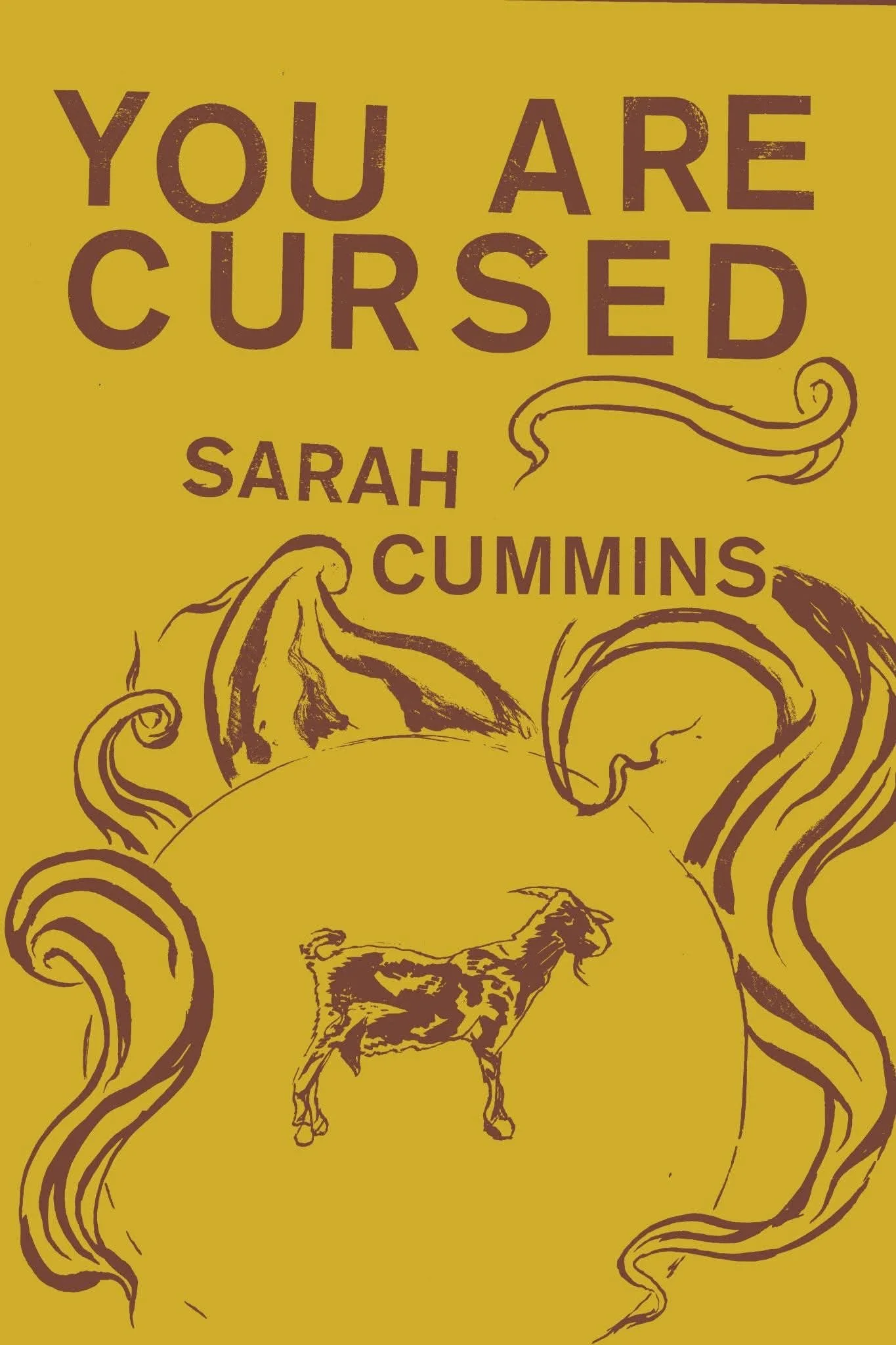
You Are Cursed, out on May 3 from Organ Bank, is the fictional diary of a high schooler who believes they have been digitally cursed by members of an occult groupchat. It’s a funny, painful story that teeters between absurd unreality and a crushingly real sense of dread. (“I’m just I guess playing like tamogatchi or something...sometimes it literally feels like I am trying to hit the right combination of buttons to prevent someone from killing themselves and that that’s all I’m doing all day,” the protagonist writes.)
Sarah and I met at a cafe to talk.
What inspired you to write this book?
Well, my knee was dislocated, which has happened a few times in my life. I was out of work for three or four weeks. I just felt really bad, and I was looking for something to do, essentially. And I got this idea where I was suddenly realizing how much I had written as a teenager, just in people's direct messages, and I think in a somewhat similar style to how the book is. So I just started from there, basically. I wrote that so quickly. There's a lot of editing, but...
How long did it take you?
I mean for the first draft, it only took pretty much the duration of my medical leave, so it was, like, a month.
Wow.
And then it slowly got whittled down, and then added to a little, and then whittled down. But that was two years ago now. That's crazy.
I love the epigraph, “To everyone I ever forgot.” The book really captures how people on the internet are constantly leaving traces but can also vanish suddenly and without explanation. Could you talk about what memory, permanence and impermanence mean to you in an online context?
Yeah, I mean, there's a lot of characters that are only named once, that just show up, because I think that is also an aspect to it. There are people all around, constantly, who you only think about when they're directly in front of you on the screen. And a lot of the time, you only think about those people once they have completely stopped posting. And a lot of the people that I, especially around that time as a teenager, was becoming friends with —it was just so totalizing being friends with them, in the first few months of meeting them. I got this sense that I actually was seeing these posts as something immediate and real. And then I guess the fact that it actually is not permanent whatsoever was sort of shocking.
So were you in similar online spaces to the ones in the book?
I was definitely in similar spaces. I mentioned some real things, like I talk about the Doggeaux group chat at some point. But yeah, I was in a few insanely weird group chats with other sixteen-year-olds, where everybody was just making stuff up all of the time and collectively going crazy together. And it's mostly fictional in the book, but there are some things...some of the stuff that happened was insanely funny. Like the thing about the Korean mafia, that was something that actually—well, I don't know if it was real. It read as insanely fake to me at the time. But I also felt like I needed to take it seriously. Which I guess is the whole book.
The book feels very true to the rhythms of journaling, especially in the way the same ideas and preoccupations of the protagonist keep coming up. How did the structure emerge? Did you struggle at all with having that realistic portrayal of a journal’s flow while still telling an engaging story?
Yeah, definitely. I think the curse is what was tying everything together. If there wasn't some sort of mystery for the protagonist to solve, then it would've just fallen apart completely. But a lot of the stuff I cut out was just stuff where I was laundering what I was feeling at that time through it, so some of the rhythm came naturally from that. I think I cope better than the character in the book, so the journaling aspect wasn't quite as frantic.
I like how the grammar and spelling break down more in moments of greater emotional intensity.
I would just type really fast, and if I didn't type fast enough, I would retype it. And you know, that was really hard in editing because sometimes it was completely un-parseable. And those are the moments where it's harder for the narrator to focus on whatever they're talking about, too, so I think that the style does a lot for making it entertaining. But yeah, essentially I was just typing really, really fast. ‘Cause I type, like, 95 words per second. I think I was probably going, like, 115 at some points. My fingers were moving so quickly.
You make a lot of interesting choices about what information to include and what to omit. I’m thinking of things like when the narrator is scared of running into this guy Stunna Boy and says there’s “something wrong with him,” but you never find out what —
No, Stunna Boy was also a real guy.
Oh, that’s a real guy, okay.
He was a niche sort of Internet celebrity, I guess. He's kind of a quote- unquote “lolcow.” Everybody was cruelly making fun of him.
I was kind of a Luddite child.
Oh, that’s totally reasonable.
[My tea is ready. I go to the counter to get it, and I leave the recording app running.]
I could say something really secret right now that you’d only hear later. But I don’t have any ideas.
[I return.] Okay, so, Stunna Boy.
He was always bragging about having bargain bin games from GameStop, so he’d just post a bunch of pictures of Xbox games and go, like, “no one has the money I have.” That was pretty awesome. I don't know. I never tried to talk to him, but a lot of people were being very mean about it.
But I was also thinking about how you keep alluding to the protagonist’s family dysfunction but don’t really go into it much. There’s a very strong sense that you’re reading someone’s specific account and that a world exists outside of it. How did you make those kinds of choices about what to leave out?
I think the family dynamic being so specific without elaboration is—I guess the idea is just terrible priorities in trying to solve your issues or trying to process what's happening. Because presumably the narrator is just talking about all of this internet stuff to their therapist, not the things happening immediately around them. But I don't know. I didn't think about it that much, frankly.
Do you have thoughts on how to effectively portray the internet in writing, or what the future of the so-called internet novel is?
I tried to sidestep a lot of that because I think that discourse is insanely annoying in general. And I mean, I'm not gonna lie and say that I think My First Book by Honor Levy is good, ‘cause I read that, it's not good. All of these writings that focus specifically on memes are just totally missing the point. I don't think memes are what's actually interesting about the internet, especially social media. Like yeah, I guess that is how right wingers get radicalized or whatever. Well, I don't even know if that's true. That’s what they say.
There's an experience of the internet that is not based around totalizing zeitgeist. I think these novels focus, typically, on this idea of, like, “oh, we're seeing everything at all times.” But for the majority of people, I think their experience is less specialized by ideology and more specialized by the people you're around. The majority of people on the internet are just using it to talk to people they actually know in real life.
I guess what I'm saying is in these internet novels that I’ve read, the obsession is with these characters who are spending a lot of time on the internet, looking at memes, making memes, getting radicalized, and learning all of these new words, which I think is definitely part of the internet experience. But I do also think that there's not as much of an alienation from others on social media as is portrayed. I mean, maybe that's true of the writer’s experience, and that's fine, but that being the only narrative is very odd to me.
Your protagonist does feel very alienated.
But they also don't see the internet as being any different from real life, in a sense where they would like to keep it separate, but that's just not realistic. Like, their coworker follows them on Twitter, and then they think that their entire life is going to collapse over that.
Are there any writers you think are particularly good at portraying the internet?
Amygdalatropolis by B. R. Yeager and The Sluts by Dennis Cooper are the only books I’ve read about anonymity on the internet that are willing to get dark enough to properly address the social aspect of how people use forums to find justifications for being bad people. The alt lit stuff that’s supposed to be about the same type of thing is all very unemotional and tongue in cheek and above it all in tone.
I haven't read Jordan Castro. And I think Tao Lin is terrible, frankly. I think Tao Lin’s a very bad writer. But I also do think that the fact that he got into MAHA and stuff over trying to cure his autism is definitely, like...Leave Society is much closer to what an experience of the internet actually is, considering he's just harassing his father the entire book. He’s trying to make his dad do the same stuff that's making him vomit blood all of the time. And if you're looking for something about radicalization, then, other than the fact that that's written by a MAHA guy, I think that’s pretty interesting. But I do also think he's a bad writer.
Are Etsy witch curses real?
That’s a good question. I think I will go on the record as saying absolutely not.
I don't think curses are real in general. I don't think magic is real. I would love if it was. Because it also is funny, conceptually. Like, wizards are funny. I would love if there was a way for people to go around and put their hands up and shoot laser beams at people and stuff, but I just unfortunately don't think that's realistic.